Monday, October 31, 2011

An Unoffical Queen

     There are prom queens, parade queens, and royal queens...some gorgeous and some not so much.  Let me introduce you to a queen with an extremely dominating nature, Emma Sweringen known as the Idaho Sheep Queen.  In the fictional novel The Sheep Queen written by Thomas Savage, you'll meet a woman who receives 2 sheep upon her marriage and ends up with 10,000 of them.

     Emma is the strongest character in this book set in the first half of the 20th century.  The story centers around Emma's granddaughter, Amy, who was given up for adoption 3 weeks after her birth.  

The Sheep Queen art journal page


    After both of her adoptive parents die, Amy sets out to discover what she can about her natural family.  She is able to locate a writer, Tom, on the East coast who actually turns out to be her brother.  Of course, Tom knows that there is no way Amy could be related to the family - she must want something from them.

     Denial continues to plague Tom until he finally learns the truth about himself, Amy, and their parents.  "The Sheep Queen", highly respected by the Idaho people she lived among, might not be so well thought of if they only knew the part she played in Amy's adoption.

     In my opinion, the book is an average read.  I had expected historical fiction when I ordered the it, and the story may be about his family since Mr. Savage did grow up in the west, and his grandmother was known as "the Sheep Queen."  Other parts of the story are also similar to his own life story.  Since it's labeled as "fiction," though,  I can only assume that it isn't a true or at least part of it is made up.

     However,  if you want to read about a fascinating female character, read The Sheep Queen.

     So, remember the ladies.

                       Carol

Thursday, October 27, 2011

Two Wives at Once - Oops

     Recently I read a book, The Wives of Henry Oades by Johanna Moran with the interesting question, "who is the real Mrs. Henry Oades?"  Last night I just happened to watch an old 1940s movie, My Favorite Wife staring Cary Grant and Irene Dunne.  The movie had a somewhat similar theme as the book.

     In both, the man is married to a woman who disappears and, after a number of years, is declared dead.  The man, although very much in love with his first wife when she was living, decides to remarry.  You can guess what happens.  The first wife miraculously survives and turns up shortly after the second marriage.   Our hero is now married to two women.  Is he a bigamist?  Which one is he really married to now?

Book journal page

     The Wives of Henry Oades was a more serious look at the situation than the comedy, My Favorite Wife.  Henry Oades has married a much younger woman and is consumed with her.  When his first wife, Margaret, suddenly reappears, he is no longer attracted to her.  Margaret has suffered much in the previous years since she and their children were kidnapped by New Zealand's Maori natives.  The new Mrs. Henry Oades won't give Henry up and neither will the first Mrs. Henry Oades.  Annulment of the first marriage would make the children illegitiment and divorce in 1900 was scandalous.  Besides, she still loves Henry.  Soon the second Mrs. Henry Oades becomes pregnant, and she's very much in love with Henry.

     California's legal system comes calling at the Oades' family farm where they are all living in the same house.  The situation is resolved in a way that suits everyone.

      The Wives of Henry Oades was written based on a
situation that actually came to light in a legal abstract.  It recently appears that the abstract may have been a hoax by the New York Times newspaper to point out a falacy in Californa's laws in the early 1900s.

     The movie, My Favorite Wife, isn't nearly as complicated as the book because Cary Grant has been married only a few hours before he realizes his first wife is still living.  He knows he is still in love with her.  The movie revolves around him timidly trying to tell the new wife what's what and then getting back in Irene Dunne's good graces.  Everything turns out right just like a good 1940 movie should.

     Read The Wives of Henry Oades if you'd like an interesting look at an unusual situation.

     And, remember the ladies.

                      Carol

Thursday, October 20, 2011

Fooling the Eye

       Many of the photos of ladies from the 1800s look romantic to me.  I think of Scarlett's full and fabulous shirts without thinking of the reality of wearing all the hidden structure necessary to keep such skirts puffed out and unwrinkled. 

      Around 1839, the most popular petticoats were made of horsehair.  Soon ladies began to put cording or whalebone in strategic places to help give skirts their bounce.  In 1856, an inventive Frenchman by the name of R.C. Milliet came up with the"cage" crinoline which was  constructed of 8 hoops of steel wire running around the petticoat in increasing diameter from the waist to the bottom of the skirt  The wires were held together with vertical tapes of  fabric.

        The early crinoline was dome-shaped to accomodate the rows of flounces on the skirt.  The crinoline made the skirt stand away from the body in a graceful bell.


           It's said that Empress Eugenie of France, who set the styles during the second half of the 1850s and the 1860s, loved the hoops because it kept men at a distance.  Her husband, Napoleon III, had a play written in which the leading lady wore a "grotesquelly wide" crinoline.  Eugenie immediately had one just as wide made for herself.


     By 1860, crinolines were so wide that two women were unable to go through a doorway at the same time nor sit on the same sofa together.  When walking outside, the wind could nearly upset a woman if not carry her away like a kite.


         The hooped crinolines were often unpredictable.  They tilted up behind or at the side when a lady stood near a table or chair.  When she sat down on a sofa, the crinoline might go up in front exposing her feet along with a shocking glimpse of a stockinged leg!  When walking, the hoop caused her skirt to sway from side to side knocking objects over.

         It was nearly impossible to wear a coat even during the coldest winter days with such wide skirts so capes and shawls had to be substituted.

         The total look wasn't always what a lady might wish as this photo probably taken in the early 1860s shows.


     In the 1860s, the shape of skirts began to change so that the front was more flat with the fabric moving to a train in the back.

     By 1866, the crinoline's popularity diminished as elegant bustles in back became the rage.   

     Although the fashion seems foolish to us today, the whole idea of the hooped crinoline was to make a lady's waist appear as tiny as possible by contrasting it with an extremely wide skirt.  Just think of the the weight of the petticoats and uncomfortable situations women of the times must have undergone. 


       Isn't it  amazing what we'll do to make ourselves look just as good as our girlfriends

           So, remember the ladies.

                         Carol

Monday, October 17, 2011

Warm Vanilla Sugar

Art Journal Page

      It's hard to believe that in the 1700s and much of the 1800s, washing was thought to be bad for your health.  One of the best things about the lack of bathing was that everyone smelled bad...not just some people. 

       To cover up the ugly odors, people used strong scents in their houses and on their clothes.  Most of these scents were produced at home using recipes that were passed along from one person to another.  In France during the middle of the18th century,  the people of King Louis XV's Court wanted professional perfumes.  Soon the English wanted them too.


        In London, a barber shop opened in 1730 with the owner  selling fragrances in addition to giving haircuts.  By 1800 more than 100 fragrances were being made in the back room of the shop, packaged, and sold up front in the store called Floris.  If a lady wanted her own fragrance, it was concocted with the recipe written in a special ledger.  Floris is still open at 89 Jermyn Street.

     After WWI, returning U.S. soldiers brought home to the women in their lives some of the European beauty products, including French perfumes, and American women started using them.  By the 1950s perfume was still an expensive luxury usually given to a woman as a gift.  She would use it on special occasions with just a dab behind each ear. 

     One of the most romantic stories told in the book Fragrance and Fashion, is that of Caron which Ernest Daltroff began in Paris in 1903.  Daltroff, who is said to have an instinctively brilliant 'nose,' met the dressmaker Felicie Vanpouille in 1905.  She designed most of the flacons for their fragrances and directed their presentations throughout the years.  In 1922, Daltroff gave Felicie half of the business.  Even though they were lovers for more than 30 years, she wouldn't marry him.  Later she married another man. 

     Daltroff was Jewish so things became tough for him when the German's began to raise their anti-Jew campaign in 1939.  Daltroff left the business in Felicie's care when he emigrated to Canada dying in New York in 1941.  His assistant 'nose' took over as perfume designer using the hundreds of recipes for new fragrances that Daltroff had written on scraps of paper.

    What about Felicie who had sparked so many of Daltroff's ideas and carried them out?  She sold the company in 1962 but continued to work for the new company until her retirement in1967 at the amazing age of 94!

     So, remember the ladies.

                      Carol

Thursday, October 13, 2011

The Peabody Girls

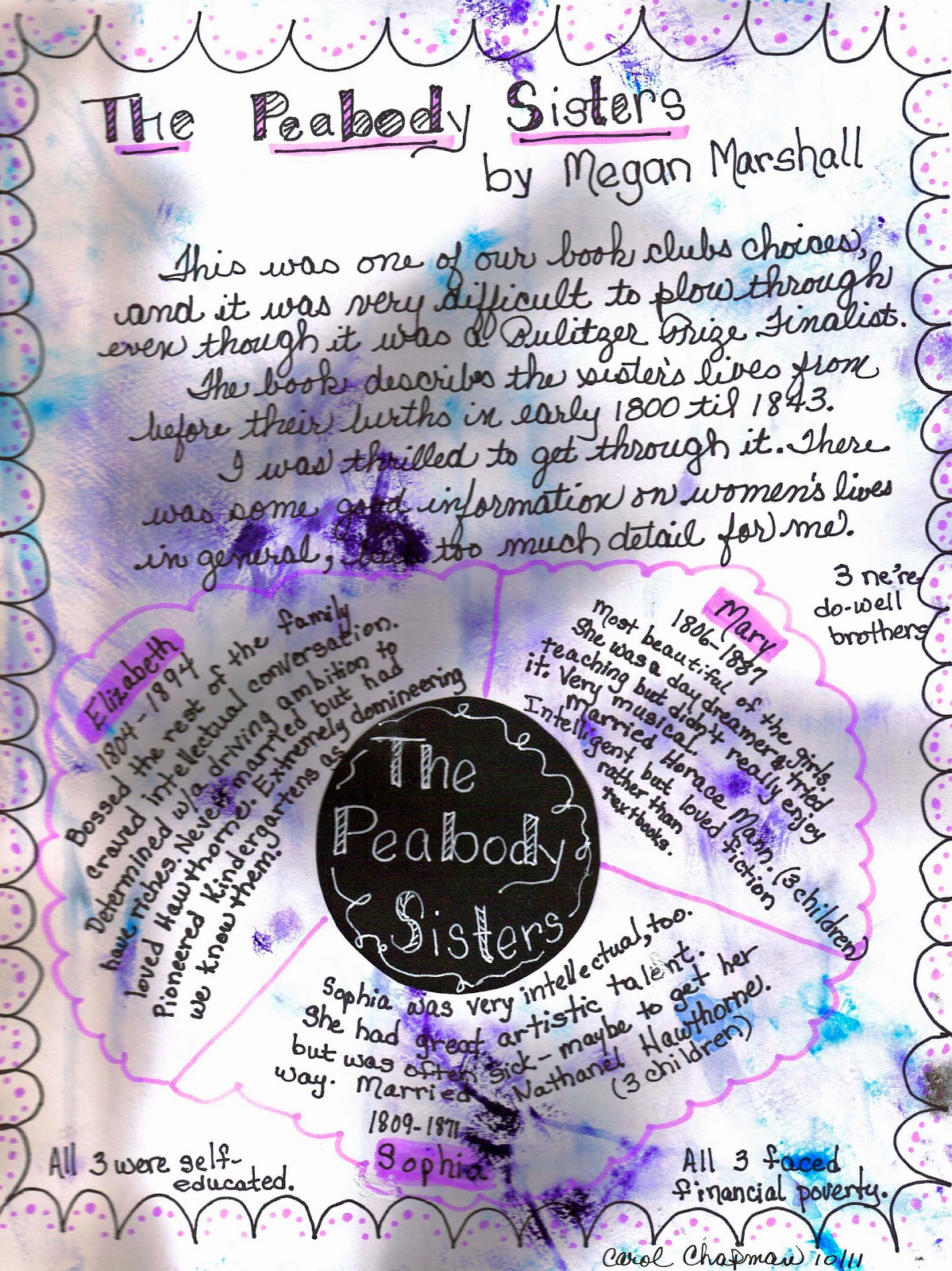
     My book club selection for last month sounded a little intriguing to me before I started reading it because I have my own sister, and I love knowing about her life.  However,  The Peabody Sisters by Megan Marshall may have been chosen as a finalist for the Pulitzer Prize, but it's not a book to pick up for pleasure.  Well documented, the story of these remarkable sisters lives from their births in the early 1800s until 1843 took forever to read.  At last I reached the end but didn't attempt the pages and pages of research notes.  So much for intrigue.

The Peabody Sisters
Book Art Journal Page
      Born in the early 1800s at a time when girls and women were considered less important and less intelligent than men and boys, the 3 Peabody sisters weren't allowed to attend school so they directed their own educations themselves.  The girls  challenged themselves to learn everything they could including several foreign languages  They were all quite intelligent and their mother, Eliza, encouraged them to grow up to be independent women.

      Elizabeth (1804-1894), domineering and the most independent of the girls, was eventually the founder of our American kindergarten system.

      Mary (1896-1887) would marry Horace Mann, have 3 children, and leave an unpublished novel behind after years of teaching.  She was the most beautiful of the sisters and the one with musical ability.

      Sophia (1809-1871), used her migranes as a crutch to get out of responsibility, married Nathaniel Hawthorne, bore 3 children but quit her sculpture and painting when the children came.

     Poverty ridden, these three women had a thirst for better lives especially Elizabeth who worked tirelessly to gain that end.  They all worked as teachers sporatically which was one of the only acceptable occupations for women at the time.  Their three brothers, who had received good educations, didn't apply themselves in the same way as the girls.  Two of the boys died in their twenties, and the third ended up being bitter towards his sisters.

     Even though the girls had some problems among themselves, they remained united throughout their lifetimes.  Elizabeth had, at one time, fallen for Horace Mann only to see him marry her sister Mary.  The man Elizabeth felt she really loved, however, was Nathaniel Hawthorne who chose Sophia for his wife.  In the end, Elizabeth never married although she had several close male friends who stimulated her intellectually.

     In my opinion, its interesting to note the changes in attitudes toward women and their worth.   The self-motivation of these women is remarkable especially at a time when there were so few options open to them.   Perhaps life is just too easy for the young of today.

     So, remember the ladies.

                       Carol