Showing posts with label books. Show all posts

Monday, November 14, 2011

Rose O'Neill

     The name "Rose" has always been a favorite of mine because of the images created in my imagination of breathtaking blossoms and fragrant scents.  I like the name "Rose O'Neill" for its Irish sound, too. 

     Rose, best known for her Kewpie illustrations, was born into a pleasantly wealthy family on June 25, 1874.  Father owned a book store and art gallery in Wilkes-Barre, PA.  Unfortunately, Father wasn't a good businessman or a good manager.  Meemie (Mother), who had been a teacher before marriage,  loved music and often gave piano lessions as well as home schooled Rose and her older brother, Hughie.

     Life was good in Wilkes-Barre until 1878 when Father lost the bookstore and decided to solve the family's financial problems by moving them out west to a sod house in Nebraska. It was a hard life especially when compared the to comforts of their old home. 


Rose O'Neill Book Journal Page
     Rose drew all the time and enjoyed drawing the elves and fairies of Father's stories.  During these years, the family increased in numbers as new babies were born, and they were often evicted from their rented homes because of Father's inability to manage the family money.   Several times he couldn't pay the tuition for Rose's schooling so she would be forced to leave.  He did, however, take her to the theater when he could because he had decided that Rose would make a splendid actress.

     The family moved to Omaha, and Rose did land a part with a traveling troop of actors when she was 14 years old.  The next year she again traveled with a troop, but she did illustrations as well and decideded that her future wasn't in acting. 

     In 1893, Father decided that Rose would have more opportunity in NYC than in Omaha, so he deposited her there and returned to the family in Nebraska.  At this particular time, there was a demand for illustrator/painters so commissions kept Rose quite busy.  She sent the money she made home to support the family.

     After about a year, Rose returned to her family who were now living in the Ozarks in a place they named Bonniebrook.  Rose loved it there and never returned to live in New York permantly. 

     In 1909, the Ladies Home Journal introduced her Kewpies and their motto, "do good deeds in a funny way."  The Kewpies were a tremendous success with dolls being sold by 1914.  All in all, Rose created some 5,500 illustrations for books, magazines, and newspapers.

     Rose married twice but had no children of her own.  She transformed Bonniebrook into her "dream home" where she supported her family retiring in 1939.  Rose died a few years later in 1944.

     Linda Brewster wrote a book entitled, Rose O'Neill the Girl Who Loved to Draw.  Even though the book is written for a young audience, it is filled with a few examples of artwork by Ms. Brewster and many pieces of Rose's lovely work. She was Rose O'Neill...America's first woman comic artist.

      So remember the ladies.

                        Carol

Wednesday, November 9, 2011

Africa with Lipstick

Although this isn't a photo of Mary Kingsley,
she probably dressed as the woman shown
above.

   Although I've never been one to want to go to Africa on safari, I do like to learn about those brave women who dared go there back "in the old days."  Several years ago, I researched an English woman who loved West Africa so much that she made two trips there and would have returned for a longer visit if she hadn't died of typhoid at the Cape of South Africa where she had gone to be a nurse during the Boer War.  The year was 1900, and Mary Kingsley  was 37 years old at her death.

     During Mary's second visit to West Africa in 1895, she collected fish specimens for the British Museum, studied the natives, and took a lot of photographs.  Back in England, she wrote popular books and gave lectures about her experiences.  People wanted to hear about polygamy among the natives and their other strange practices.

      Copies of Mary's book Travels in West Africa  and A Voyager Out by Katherine Frank tell of Mary's experience.

       A few days ago, I bought a copy of the March, 1928, Vanity Fair magazine at a flea market.  While paging through it, I found an article entitled "Through Africa with Lipstick and Camera" by Mrs. Corey Ford.  The article was filled with little tidbits about her African life while accompanying her explorer husband as he photographed wild animals.  She was to pose with the wild animals killed by the natives.  According to Zaza, a lady explorer had to endure a few hardships and take only the barest necessities. 

Photo supplied by Metro-Goldwyn probably to
promote a film of the time.
            "Of our modest train of 100 coolies, the first 5 or 10 carried trunks on their backs containing my evening-wraps, slippers and cloaks.  The next dozen brought a few little changes for early afternoon wear, and some simple morning frocks; the succeeding four or five staggered under my array of chemises, negligees, stockings, and other personal effects; the next squad carried my shoes and slippers; the next 12 my hats; while the succeeding forty-odd coolies carried such indespensible articles of my toilet as cosmetics, facial creams, powders, rouge, and some framed photographs of myself to decorate my boudoir.  The last coolie brought up the rear with my bath-salts and Corey's suitcase."
     
     Zaza Ford claimed to sometimes spend evenings with Martin and Osa Johnson, actual famed African explorers who spent many years in the wilderness.

As I read the article written by this Mrs. Corey Ford,  I wondered if it could possibly be real.  It was such a contrast to Mary Kingsley's African experience, but then Mary was a minimalist.  It is true that some early women on safari took a staggering amount of items with them.  Mrs. Ford's article made me laugh, so I decided to do some research on her.  Not surprisingly, I couldn't find out anything about her, but I did discover that Corey Ford was a writer of the times who wrote humor and satire for various magazines (including Vanity Fair) along with some books.  So, I'm guessing this is probably one of his satire articles pointed at the ridiculous amount of beauty products and costumes some women deemed necessary for travel in the wilds of Africa.  Can't you just picture a caravan of 100 "coolies" with 99 of them totting clothing and accessories for a spoiled hieress?  That's my kind of roughing it!

     So, remember the ladies.

                      Carol

Monday, October 31, 2011

An Unoffical Queen

     There are prom queens, parade queens, and royal queens...some gorgeous and some not so much.  Let me introduce you to a queen with an extremely dominating nature, Emma Sweringen known as the Idaho Sheep Queen.  In the fictional novel The Sheep Queen written by Thomas Savage, you'll meet a woman who receives 2 sheep upon her marriage and ends up with 10,000 of them.

     Emma is the strongest character in this book set in the first half of the 20th century.  The story centers around Emma's granddaughter, Amy, who was given up for adoption 3 weeks after her birth.  

The Sheep Queen art journal page


    After both of her adoptive parents die, Amy sets out to discover what she can about her natural family.  She is able to locate a writer, Tom, on the East coast who actually turns out to be her brother.  Of course, Tom knows that there is no way Amy could be related to the family - she must want something from them.

     Denial continues to plague Tom until he finally learns the truth about himself, Amy, and their parents.  "The Sheep Queen", highly respected by the Idaho people she lived among, might not be so well thought of if they only knew the part she played in Amy's adoption.

     In my opinion, the book is an average read.  I had expected historical fiction when I ordered the it, and the story may be about his family since Mr. Savage did grow up in the west, and his grandmother was known as "the Sheep Queen."  Other parts of the story are also similar to his own life story.  Since it's labeled as "fiction," though,  I can only assume that it isn't a true or at least part of it is made up.

     However,  if you want to read about a fascinating female character, read The Sheep Queen.

     So, remember the ladies.

                       Carol

Monday, October 17, 2011

Warm Vanilla Sugar

Art Journal Page

      It's hard to believe that in the 1700s and much of the 1800s, washing was thought to be bad for your health.  One of the best things about the lack of bathing was that everyone smelled bad...not just some people. 

       To cover up the ugly odors, people used strong scents in their houses and on their clothes.  Most of these scents were produced at home using recipes that were passed along from one person to another.  In France during the middle of the18th century,  the people of King Louis XV's Court wanted professional perfumes.  Soon the English wanted them too.


        In London, a barber shop opened in 1730 with the owner  selling fragrances in addition to giving haircuts.  By 1800 more than 100 fragrances were being made in the back room of the shop, packaged, and sold up front in the store called Floris.  If a lady wanted her own fragrance, it was concocted with the recipe written in a special ledger.  Floris is still open at 89 Jermyn Street.

     After WWI, returning U.S. soldiers brought home to the women in their lives some of the European beauty products, including French perfumes, and American women started using them.  By the 1950s perfume was still an expensive luxury usually given to a woman as a gift.  She would use it on special occasions with just a dab behind each ear. 

     One of the most romantic stories told in the book Fragrance and Fashion, is that of Caron which Ernest Daltroff began in Paris in 1903.  Daltroff, who is said to have an instinctively brilliant 'nose,' met the dressmaker Felicie Vanpouille in 1905.  She designed most of the flacons for their fragrances and directed their presentations throughout the years.  In 1922, Daltroff gave Felicie half of the business.  Even though they were lovers for more than 30 years, she wouldn't marry him.  Later she married another man. 

     Daltroff was Jewish so things became tough for him when the German's began to raise their anti-Jew campaign in 1939.  Daltroff left the business in Felicie's care when he emigrated to Canada dying in New York in 1941.  His assistant 'nose' took over as perfume designer using the hundreds of recipes for new fragrances that Daltroff had written on scraps of paper.

    What about Felicie who had sparked so many of Daltroff's ideas and carried them out?  She sold the company in 1962 but continued to work for the new company until her retirement in1967 at the amazing age of 94!

     So, remember the ladies.

                      Carol

Thursday, October 13, 2011

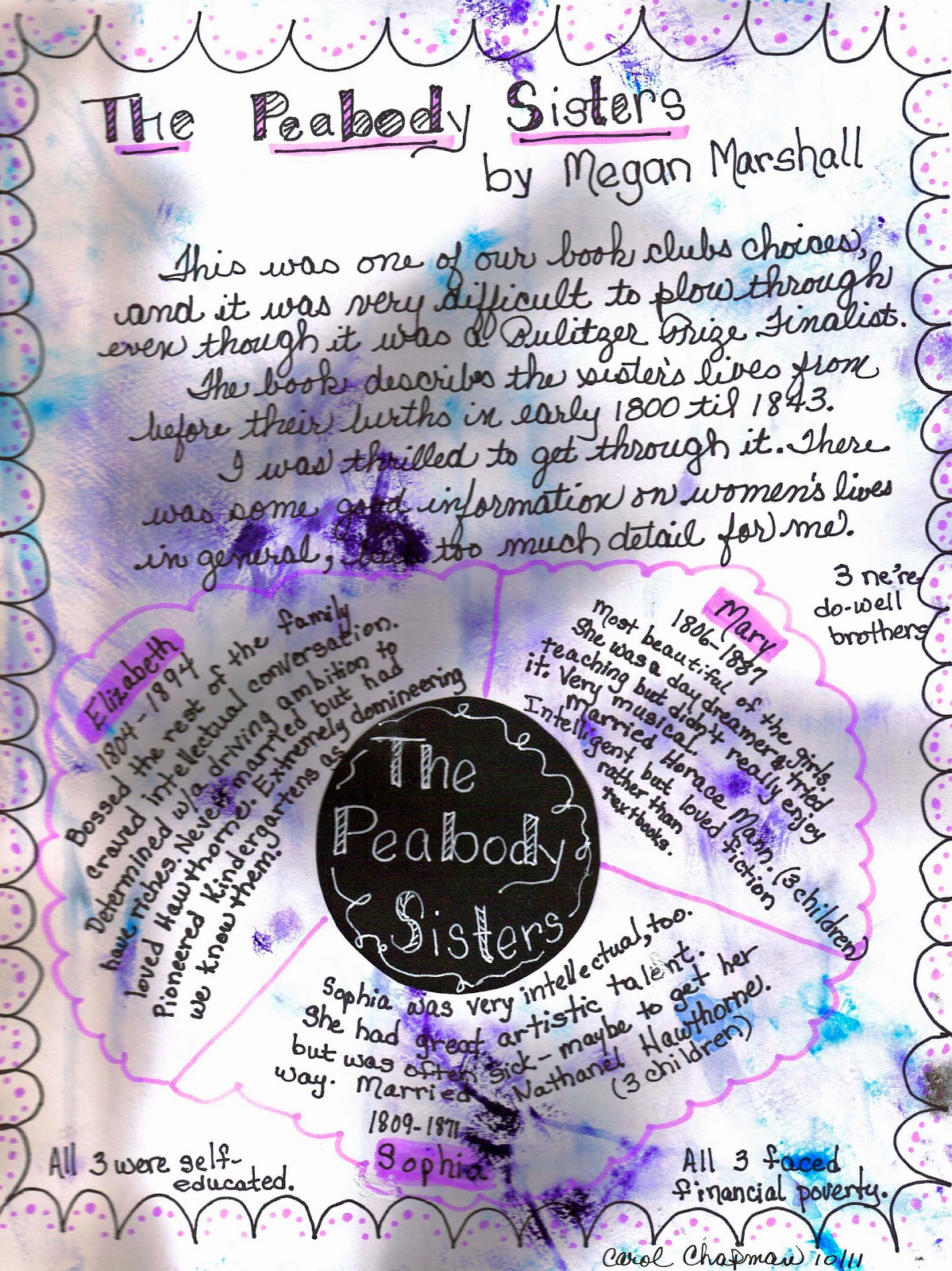
The Peabody Girls

     My book club selection for last month sounded a little intriguing to me before I started reading it because I have my own sister, and I love knowing about her life.  However,  The Peabody Sisters by Megan Marshall may have been chosen as a finalist for the Pulitzer Prize, but it's not a book to pick up for pleasure.  Well documented, the story of these remarkable sisters lives from their births in the early 1800s until 1843 took forever to read.  At last I reached the end but didn't attempt the pages and pages of research notes.  So much for intrigue.

The Peabody Sisters
Book Art Journal Page
      Born in the early 1800s at a time when girls and women were considered less important and less intelligent than men and boys, the 3 Peabody sisters weren't allowed to attend school so they directed their own educations themselves.  The girls  challenged themselves to learn everything they could including several foreign languages  They were all quite intelligent and their mother, Eliza, encouraged them to grow up to be independent women.

      Elizabeth (1804-1894), domineering and the most independent of the girls, was eventually the founder of our American kindergarten system.

      Mary (1896-1887) would marry Horace Mann, have 3 children, and leave an unpublished novel behind after years of teaching.  She was the most beautiful of the sisters and the one with musical ability.

      Sophia (1809-1871), used her migranes as a crutch to get out of responsibility, married Nathaniel Hawthorne, bore 3 children but quit her sculpture and painting when the children came.

     Poverty ridden, these three women had a thirst for better lives especially Elizabeth who worked tirelessly to gain that end.  They all worked as teachers sporatically which was one of the only acceptable occupations for women at the time.  Their three brothers, who had received good educations, didn't apply themselves in the same way as the girls.  Two of the boys died in their twenties, and the third ended up being bitter towards his sisters.

     Even though the girls had some problems among themselves, they remained united throughout their lifetimes.  Elizabeth had, at one time, fallen for Horace Mann only to see him marry her sister Mary.  The man Elizabeth felt she really loved, however, was Nathaniel Hawthorne who chose Sophia for his wife.  In the end, Elizabeth never married although she had several close male friends who stimulated her intellectually.

     In my opinion, its interesting to note the changes in attitudes toward women and their worth.   The self-motivation of these women is remarkable especially at a time when there were so few options open to them.   Perhaps life is just too easy for the young of today.

     So, remember the ladies.

                       Carol

Monday, October 10, 2011

What's a Hooverette?

     A Hooverette sounds like some kind of vaccume cleaner or a cheerleader of some sort doesn't it?  Actually, it's the name of a type of housedress designed and worn in the late 1920s and 30s possibly to conserve water, laundry soap and clothing.  The dresses had a "lap" front.  You would lap one side over the other and fasten it with a tie.  When that side got soiled, you simply lapped the other side over the dirty one.

     Before WWI, all wealthy and most middle class families had household "servants" to keep things neat and tidy.  The war changed things as it modernized the world creating more desirable jobs for those workers.  Wives found themselves having to do much of the housework themselves.  It was unthinkable to go to the door if callers came wearing an apron so the Hooverette was a good substitute.

Woman on right wears
a Hooverette which ties
in back.


     Hooverettes were sometimes referred to as either Hoover Aprons or, more commonly, morning dresses since the women did their housework in the morning then changed their clothes to go "out" in the afternoon for shopping, visiting friends, and other vital errands.  The morning dresses were made of inexpensive cotton fabric which washed easily.  Sold cheaply at 2 for 95 cents in the 1935 Sears catalog, a woman could possibly have more than one.  Simplicity pattern #1151 (not shown) from 1932-3 was for a Hooverette dress so the industrious woman could make her own.


     According to Barbara Brackman's book Making History:  Quilts and Fabric from 1890-1970,  no one is certain how the dress got it's name, but it may have been named in honor of conservative President Herbert Hoover who took over the presidency at the beginning of the 1929 and served until 1933.  Hoover was blamed for the depression although he didn't cause it...but someone must take the blame.  However it got it's name, the Hooverette or Hoover apron is simply an inexpensive work dress.

1930 Hooverette Art Quilt
8 3/4" X 11"


     Here's my version of a Hooverette dress worn in the 1930s along with some sensible shoes.  Dirt won't show much on this print fabric.


     Now we wear jeans to do our housework, though society didn't permit them at that time.  We've come a long way in our dress liberation, haven't we?

     So, remember the ladies.

                     Carol

Thursday, October 6, 2011

The Amazing Walker Sisters

     Sometimes when I think about the will power it takes to fight against someone or something much bigger and stronger than we women are, it amazes me that there are those out there who refuse to budge from their beliefs.  Meet the amazing Walker Sisters of the Great Smoky Mountains.

     If the United States government came to you and said that they were taking the land you'd been born and lived on all of your life in order to make a national park, would you be able to look those government agents in the eye and say, "I don't think so."

     That's what Martha, Polly, Hettie, Margaret, Nancy, and Louisa Walker did following the 1926 bill passed by Congress to allow the formation of the Great Smoky Mountain National Park.  In 1931, property in the area was condemned, but the Walker girls didn't care.  They didn't intend to move away from their 122.8 acres, and they didn't!

     Of the 11 children born to John and Margaret Walker, 6 of the girls remained single, 1 married as did the 4 boys.  The 6 single daughters lived their lives out in their small cabin which they kept "neat as a pin."  Each year they would scrub the walls with boiling hot water before re-wallpapering it over with newspapers, magazines, calendars, and the like.  Then they rehung their pictures and hundreds of items on the walls.

Room Box of Margaret & Louisa Walker
along with some of their possessions.
Items pictured are from the book,
The Walker Sisters of Little Greenbrier
by Rose Houk.


     It was a simple life without electricity, gas engines, running water, or an outhouse which they felt would be too embarrassing for them because people would know what it was used for.  They had all attended school through the 6th grade so they weren't illiterate.  They simply liked things the way they were and had no desire to change anything.


Back of room box listing the Walker Sisters, two books
about the Sisters, and a brief summary of their lives.


  When the National Park Service sent agents to try to force the Walker Sisters into selling their land between the years of 1926 through 1940, the girls refused although at one times they did tell the agents  they would sell their land for $15,000 which was far above what the agents were authorized to pay.  Over the years, the girls reduced their price two or three times, but they wanted to remain on the land throughout their lives.  It's been said that President Roosevelt paid the Sisters a surprise visit, and a few months later, a deal was made whereby they received $4750 and the right to live in their house for the rest of their lives.

     A simple life isn't as easy as it may look.  Carding, spinning, weaving, and sewing
their long sleeved ankle-length dresses was time consuming as was making their leather shoes, socks,  butter, soap and shampoo.  They grew over 20 varieties of apple trees and more than 100 varieties of flowers and shrubs.  They also farmed, raised animals, and were knowledgeable about herbs.

     In 1946 "The Saturday Evening Post" included an article about the Great Smoky Mountain National Park and the Walker Sisters which caused tourists to flock to see them.  Before the girls decided to take advantage of the tourist trade, they posted a "Keep Out" sign then changing  it to one saying "Visitors Welcome."  They sold the tourists apples, fried apple pies, homemade soap, pinecones, nuts, dolls, quilts, poetry written by Louisa, and assorted other items which they made.  As the years went by, these sales helped support them.

     The first of the sisters to die was Nancy in 1931.  The other 5 died during the next decades with the last, Louisa passing away in 1964.  In the early 1950s, the 2 remaining sisters then 70 and 82 asked the Park Superintendent to remove the Walker Sisters sign as their health wasn't so good by then. 

      It's not often we hear about such independent, self-supporting women who lived lives so unchanged and found happiness without the comforts we take for granted.  Although they did adopt a few of the more modern conviences of the times, they basically attempted to live good lives in the simplest way they knew how.

      Rose Houk wrote a book called, The Walker Sisters of Little Greenbrier and Bonnie Trentham Myers wrote The Walker Sisters:  Spirited Women of the Smokies.  Both of these books give insight into what life was like for the amazing Walker Sisters.

      So, remember the ladies.

                              Carol

Monday, October 3, 2011

The Strength of a Woman

     When I was cleaning out a cupboard, I ran across a book about the Navajo Indians' struggle for survival...a book I kept thinking I would read but just never got around to doing til now.    She Who Hears The Sun, a historical novel written by Pamela Jekel, tells the story of four generations of women beginning in 1846.  Prior to that time, "The People" migrated to various grazing lands to feed their animals but always returned to their permanent homes.  

     The women of the Navajo tribe owned the herds of sheep and goats, the pastures, the hogans (homes), and they attended the council meetings.  A smart man stayed on the good side of his wife since he might be married to 1 or 2 other women at the same time who had adjoining pasture land.   The wife could end the marriage by simply placing all of the husband's belongs outside her hogan door. 

     It was a free life until 1846 when the white man arrived with the intention of taking over the land by pressuring the Indians into signing treaties and making promises the army failed to keep.  Eventually, the Navajos were hunted down and forced to die or move to a distant reservation where they would be provided with food, seeds, tools, etc..  The surviving Navajo tribe members were allowed to return to their homes in 1868 when the government finally realized they couldn't take care of them.  The Navajos  agreed to send their children to a white school, not fight with the other tribes, become farmers, and stay on the new reservation which was part of their old home lands.

Indian Wisdom Art Quilt
   In this book, Deezbaa is a wise old Grandmother who thinks that the mind is like a garden.  We must plant and tend only those things which will nurture us.

    Her daughter, Ayoi, doesn't have the strength of will which Deezbaa posesses.  The strongest in this line of women is Ayoi's daughter, Pahe who helps the Navajo tribe continue living when they've nearly all given up hope of ever being allowed to return to their homes.  Pahe becomes the stable influence the tribe needs.

     Although this isn't the best book I've ever read, Ms. Jekel writes in a way that made me feel some of the anguish these women must have felt as they lost many of their family members, friends, homes, and their way of life.  Through Pahe there is a glimpse of the strength it took to survive and even prosper again. 

     So, remember the women!
                 
                             Carol
           

Thursday, September 29, 2011

Remarkable Creatures

     The book Remarkable Creatures by Tracy Chevalier didn't hold much appeal when I read the synopsis on the back cover since dinosaurs and fossils aren't a huge interest of mine.  However, the book turned out to be a pleasant surprise.

Remarkable Creatures
Art Journal Page
     This work of historical fiction tells of 2 English women who became friends in the early 1800s when the spinster Elizabeth Philpot and her 2 sisters moved to Lyme Regis where they could live in gentle poverty.  There Elizabeth met a genuinely impoverished young girl, Mary Anning and her family.  Even  with several years difference in their ages, they formed a bond that lasted for many years despite several ups and downs.

      Mary, a born "fossil hunter" who could locate dinosaur bones that others just overlooked, had to find bones to sell in a curio shop owned by her family.  Elizabeth wanted to search for fish fossils to display in a collection.  Mary taught Elizabeth a great deal about looking for "curies."  Together they worked to expose the first plesiosaurus and ichthyosaurus fossils ever seen in the world.

       One of the interesting aspects of this book is that it illustrates the view held by men toward women at that time..  Although they were interested in seeing the dinosaur bones found by Mary, since she was a female, she was given no credit for the work she did.  Some of the men tried to cheat her, and a few took credit for her accomplishments.

         Like The Girl with the Pearl Earring,  also by Tracy Chevalier, Remarkable Creatures has a gentle flow to it that makes for good reading.  In my opinion, the remarkable creatures aren't the fossils found by Mary and Elizabeth.  The really remarkable creatures are the two ladies themselves.

     So, remember the ladies.

                           Carol