Showing posts with label lifestyles. Show all posts

Friday, November 25, 2011

The Story of Coppelia

     For some reason I love the ballet.  I'm not musical nor do I have the coordination to have been a dancer, so maybe it's the costumes and the sets that appeal to me.  The sensual delight of ballet creates fairy tales in my mind that just end too quickly.

     A few years ago, I saw Coppelia danced by the Ballet Arizona.  This is classified as a "comic" ballet because there are no deaths or great suffering played out in the performance.  The town's mayor announces a celebration to be held the following day when the town's bell will be honored.  Sitting in the window of the shop across from the town square is Coppelia, a life-size doll, who draws the attention of Swanilda's lover, Franz. 

Coppelia - art journal page
   Dr. Coppelius, the maker of Coppelia, drops his keys as he is leaving his shop.  After Swanilda finds the keys, she and her friends decide to enter the shop.  Before they can investigate too much, Dr. Coppelius returns, and everyone runs away except Swanilda who hides in the alcove where Coppelia is sitting.  Soon Franz appears declaring his love for the exquisite Coppelia.  The two men share several drinks while Dr. Coppelius plots to take the energy from Franz and infuse it in his exquisite Coppelia.  She will be alive!  The Doctor brings out what he believes to be the doll but is really Swanilda who dances around the room.  As she does so, Franz awakens and they flee Dr. Coppelius's shop.  Only then does the doctor realize that Coppelia is lying on the shop floor.  He has been tricked.

   Act 3 shows the celebration in the village where all the  betrothed couples are given a dowry.  Swanilda gives the doctor her dowry to make up for the trick played upon him.  The remaining part of this act is devoted to dancing and rejoicing.

     Copplia was introduced to the Paris ballet audience in May of 1870.  Within a few months, France and Prussia were at war with many privations for the French people.  France's Emperor Napoleon III was defeated and there followed a period of civil unrest.  The 16 year old ballerina, Giuseppina Bozzacchi,  chosen to dance the title role of Swanilda became a casualty of the time dying of smallpox on the morning of her 17th birthday, November 23, 1870.

     Surprisingly many men enjoy this ballet as well as women.  Perhaps it is the light nature of the program or the introduction of several folk dances.  Whatever causes the magic, it's there for all to see and enjoy.

     So, remember the ladies.

                       Carol


Monday, November 14, 2011

Rose O'Neill

     The name "Rose" has always been a favorite of mine because of the images created in my imagination of breathtaking blossoms and fragrant scents.  I like the name "Rose O'Neill" for its Irish sound, too. 

     Rose, best known for her Kewpie illustrations, was born into a pleasantly wealthy family on June 25, 1874.  Father owned a book store and art gallery in Wilkes-Barre, PA.  Unfortunately, Father wasn't a good businessman or a good manager.  Meemie (Mother), who had been a teacher before marriage,  loved music and often gave piano lessions as well as home schooled Rose and her older brother, Hughie.

     Life was good in Wilkes-Barre until 1878 when Father lost the bookstore and decided to solve the family's financial problems by moving them out west to a sod house in Nebraska. It was a hard life especially when compared the to comforts of their old home. 


Rose O'Neill Book Journal Page
     Rose drew all the time and enjoyed drawing the elves and fairies of Father's stories.  During these years, the family increased in numbers as new babies were born, and they were often evicted from their rented homes because of Father's inability to manage the family money.   Several times he couldn't pay the tuition for Rose's schooling so she would be forced to leave.  He did, however, take her to the theater when he could because he had decided that Rose would make a splendid actress.

     The family moved to Omaha, and Rose did land a part with a traveling troop of actors when she was 14 years old.  The next year she again traveled with a troop, but she did illustrations as well and decideded that her future wasn't in acting. 

     In 1893, Father decided that Rose would have more opportunity in NYC than in Omaha, so he deposited her there and returned to the family in Nebraska.  At this particular time, there was a demand for illustrator/painters so commissions kept Rose quite busy.  She sent the money she made home to support the family.

     After about a year, Rose returned to her family who were now living in the Ozarks in a place they named Bonniebrook.  Rose loved it there and never returned to live in New York permantly. 

     In 1909, the Ladies Home Journal introduced her Kewpies and their motto, "do good deeds in a funny way."  The Kewpies were a tremendous success with dolls being sold by 1914.  All in all, Rose created some 5,500 illustrations for books, magazines, and newspapers.

     Rose married twice but had no children of her own.  She transformed Bonniebrook into her "dream home" where she supported her family retiring in 1939.  Rose died a few years later in 1944.

     Linda Brewster wrote a book entitled, Rose O'Neill the Girl Who Loved to Draw.  Even though the book is written for a young audience, it is filled with a few examples of artwork by Ms. Brewster and many pieces of Rose's lovely work. She was Rose O'Neill...America's first woman comic artist.

      So remember the ladies.

                        Carol

Wednesday, November 9, 2011

Africa with Lipstick

Although this isn't a photo of Mary Kingsley,
she probably dressed as the woman shown
above.

   Although I've never been one to want to go to Africa on safari, I do like to learn about those brave women who dared go there back "in the old days."  Several years ago, I researched an English woman who loved West Africa so much that she made two trips there and would have returned for a longer visit if she hadn't died of typhoid at the Cape of South Africa where she had gone to be a nurse during the Boer War.  The year was 1900, and Mary Kingsley  was 37 years old at her death.

     During Mary's second visit to West Africa in 1895, she collected fish specimens for the British Museum, studied the natives, and took a lot of photographs.  Back in England, she wrote popular books and gave lectures about her experiences.  People wanted to hear about polygamy among the natives and their other strange practices.

      Copies of Mary's book Travels in West Africa  and A Voyager Out by Katherine Frank tell of Mary's experience.

       A few days ago, I bought a copy of the March, 1928, Vanity Fair magazine at a flea market.  While paging through it, I found an article entitled "Through Africa with Lipstick and Camera" by Mrs. Corey Ford.  The article was filled with little tidbits about her African life while accompanying her explorer husband as he photographed wild animals.  She was to pose with the wild animals killed by the natives.  According to Zaza, a lady explorer had to endure a few hardships and take only the barest necessities. 

Photo supplied by Metro-Goldwyn probably to
promote a film of the time.
            "Of our modest train of 100 coolies, the first 5 or 10 carried trunks on their backs containing my evening-wraps, slippers and cloaks.  The next dozen brought a few little changes for early afternoon wear, and some simple morning frocks; the succeeding four or five staggered under my array of chemises, negligees, stockings, and other personal effects; the next squad carried my shoes and slippers; the next 12 my hats; while the succeeding forty-odd coolies carried such indespensible articles of my toilet as cosmetics, facial creams, powders, rouge, and some framed photographs of myself to decorate my boudoir.  The last coolie brought up the rear with my bath-salts and Corey's suitcase."
     
     Zaza Ford claimed to sometimes spend evenings with Martin and Osa Johnson, actual famed African explorers who spent many years in the wilderness.

As I read the article written by this Mrs. Corey Ford,  I wondered if it could possibly be real.  It was such a contrast to Mary Kingsley's African experience, but then Mary was a minimalist.  It is true that some early women on safari took a staggering amount of items with them.  Mrs. Ford's article made me laugh, so I decided to do some research on her.  Not surprisingly, I couldn't find out anything about her, but I did discover that Corey Ford was a writer of the times who wrote humor and satire for various magazines (including Vanity Fair) along with some books.  So, I'm guessing this is probably one of his satire articles pointed at the ridiculous amount of beauty products and costumes some women deemed necessary for travel in the wilds of Africa.  Can't you just picture a caravan of 100 "coolies" with 99 of them totting clothing and accessories for a spoiled hieress?  That's my kind of roughing it!

     So, remember the ladies.

                      Carol

Monday, October 31, 2011

An Unoffical Queen

     There are prom queens, parade queens, and royal queens...some gorgeous and some not so much.  Let me introduce you to a queen with an extremely dominating nature, Emma Sweringen known as the Idaho Sheep Queen.  In the fictional novel The Sheep Queen written by Thomas Savage, you'll meet a woman who receives 2 sheep upon her marriage and ends up with 10,000 of them.

     Emma is the strongest character in this book set in the first half of the 20th century.  The story centers around Emma's granddaughter, Amy, who was given up for adoption 3 weeks after her birth.  

The Sheep Queen art journal page


    After both of her adoptive parents die, Amy sets out to discover what she can about her natural family.  She is able to locate a writer, Tom, on the East coast who actually turns out to be her brother.  Of course, Tom knows that there is no way Amy could be related to the family - she must want something from them.

     Denial continues to plague Tom until he finally learns the truth about himself, Amy, and their parents.  "The Sheep Queen", highly respected by the Idaho people she lived among, might not be so well thought of if they only knew the part she played in Amy's adoption.

     In my opinion, the book is an average read.  I had expected historical fiction when I ordered the it, and the story may be about his family since Mr. Savage did grow up in the west, and his grandmother was known as "the Sheep Queen."  Other parts of the story are also similar to his own life story.  Since it's labeled as "fiction," though,  I can only assume that it isn't a true or at least part of it is made up.

     However,  if you want to read about a fascinating female character, read The Sheep Queen.

     So, remember the ladies.

                       Carol
Thursday, October 27, 2011

Two Wives at Once - Oops

     Recently I read a book, The Wives of Henry Oades by Johanna Moran with the interesting question, "who is the real Mrs. Henry Oades?"  Last night I just happened to watch an old 1940s movie, My Favorite Wife staring Cary Grant and Irene Dunne.  The movie had a somewhat similar theme as the book.

     In both, the man is married to a woman who disappears and, after a number of years, is declared dead.  The man, although very much in love with his first wife when she was living, decides to remarry.  You can guess what happens.  The first wife miraculously survives and turns up shortly after the second marriage.   Our hero is now married to two women.  Is he a bigamist?  Which one is he really married to now?

Book journal page

     The Wives of Henry Oades was a more serious look at the situation than the comedy, My Favorite Wife.  Henry Oades has married a much younger woman and is consumed with her.  When his first wife, Margaret, suddenly reappears, he is no longer attracted to her.  Margaret has suffered much in the previous years since she and their children were kidnapped by New Zealand's Maori natives.  The new Mrs. Henry Oades won't give Henry up and neither will the first Mrs. Henry Oades.  Annulment of the first marriage would make the children illegitiment and divorce in 1900 was scandalous.  Besides, she still loves Henry.  Soon the second Mrs. Henry Oades becomes pregnant, and she's very much in love with Henry.

     California's legal system comes calling at the Oades' family farm where they are all living in the same house.  The situation is resolved in a way that suits everyone.

      The Wives of Henry Oades was written based on a
situation that actually came to light in a legal abstract.  It recently appears that the abstract may have been a hoax by the New York Times newspaper to point out a falacy in Californa's laws in the early 1900s.

     The movie, My Favorite Wife, isn't nearly as complicated as the book because Cary Grant has been married only a few hours before he realizes his first wife is still living.  He knows he is still in love with her.  The movie revolves around him timidly trying to tell the new wife what's what and then getting back in Irene Dunne's good graces.  Everything turns out right just like a good 1940 movie should.

     Read The Wives of Henry Oades if you'd like an interesting look at an unusual situation.

     And, remember the ladies.

                      Carol

Thursday, October 20, 2011

Fooling the Eye

       Many of the photos of ladies from the 1800s look romantic to me.  I think of Scarlett's full and fabulous shirts without thinking of the reality of wearing all the hidden structure necessary to keep such skirts puffed out and unwrinkled. 

      Around 1839, the most popular petticoats were made of horsehair.  Soon ladies began to put cording or whalebone in strategic places to help give skirts their bounce.  In 1856, an inventive Frenchman by the name of R.C. Milliet came up with the"cage" crinoline which was  constructed of 8 hoops of steel wire running around the petticoat in increasing diameter from the waist to the bottom of the skirt  The wires were held together with vertical tapes of  fabric.

        The early crinoline was dome-shaped to accomodate the rows of flounces on the skirt.  The crinoline made the skirt stand away from the body in a graceful bell.


           It's said that Empress Eugenie of France, who set the styles during the second half of the 1850s and the 1860s, loved the hoops because it kept men at a distance.  Her husband, Napoleon III, had a play written in which the leading lady wore a "grotesquelly wide" crinoline.  Eugenie immediately had one just as wide made for herself.


     By 1860, crinolines were so wide that two women were unable to go through a doorway at the same time nor sit on the same sofa together.  When walking outside, the wind could nearly upset a woman if not carry her away like a kite.


         The hooped crinolines were often unpredictable.  They tilted up behind or at the side when a lady stood near a table or chair.  When she sat down on a sofa, the crinoline might go up in front exposing her feet along with a shocking glimpse of a stockinged leg!  When walking, the hoop caused her skirt to sway from side to side knocking objects over.

         It was nearly impossible to wear a coat even during the coldest winter days with such wide skirts so capes and shawls had to be substituted.

         The total look wasn't always what a lady might wish as this photo probably taken in the early 1860s shows.


     In the 1860s, the shape of skirts began to change so that the front was more flat with the fabric moving to a train in the back.

     By 1866, the crinoline's popularity diminished as elegant bustles in back became the rage.   

     Although the fashion seems foolish to us today, the whole idea of the hooped crinoline was to make a lady's waist appear as tiny as possible by contrasting it with an extremely wide skirt.  Just think of the the weight of the petticoats and uncomfortable situations women of the times must have undergone. 


       Isn't it  amazing what we'll do to make ourselves look just as good as our girlfriends

           So, remember the ladies.

                         Carol

Thursday, October 13, 2011

The Peabody Girls

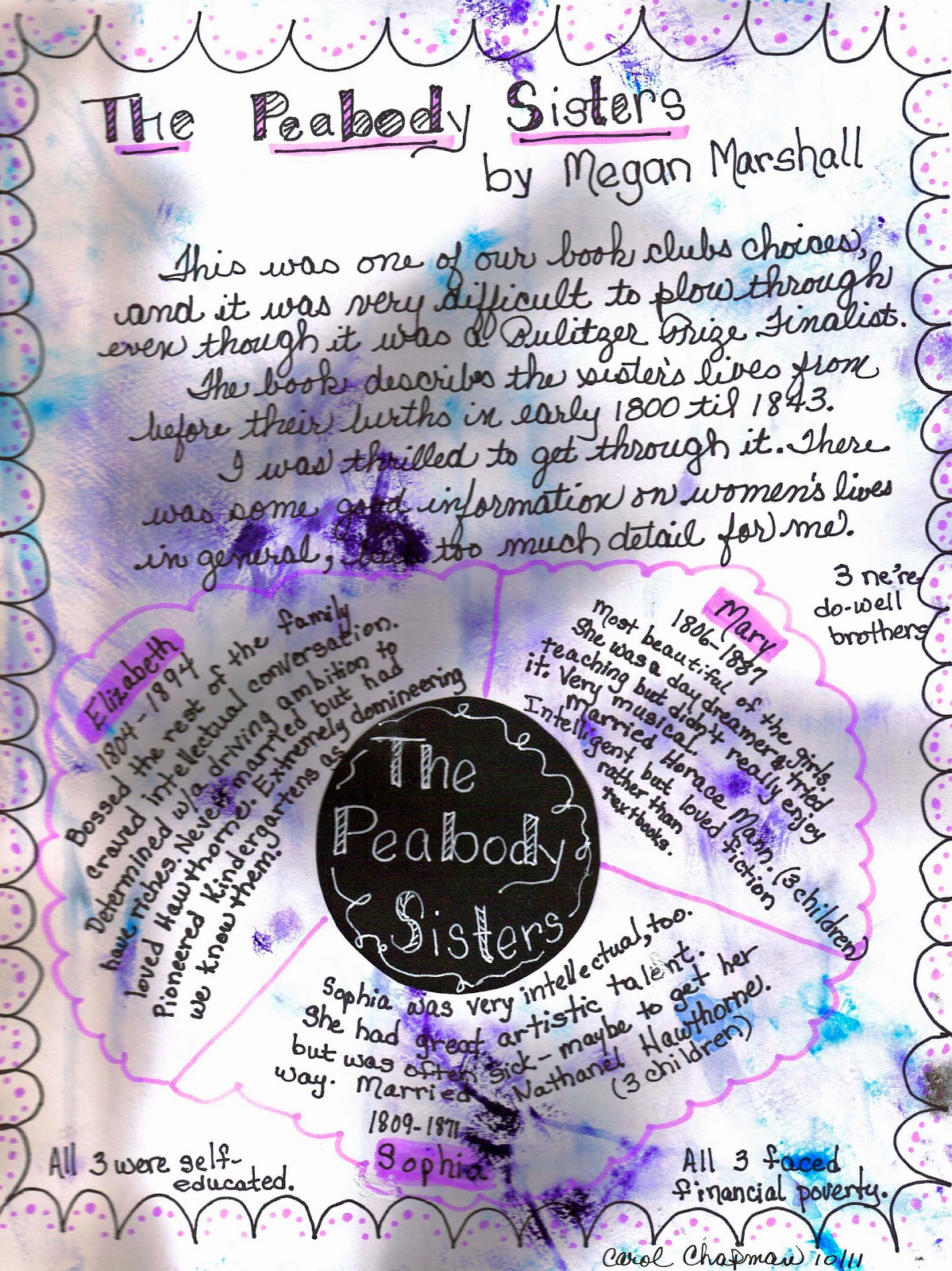
     My book club selection for last month sounded a little intriguing to me before I started reading it because I have my own sister, and I love knowing about her life.  However,  The Peabody Sisters by Megan Marshall may have been chosen as a finalist for the Pulitzer Prize, but it's not a book to pick up for pleasure.  Well documented, the story of these remarkable sisters lives from their births in the early 1800s until 1843 took forever to read.  At last I reached the end but didn't attempt the pages and pages of research notes.  So much for intrigue.

The Peabody Sisters
Book Art Journal Page
      Born in the early 1800s at a time when girls and women were considered less important and less intelligent than men and boys, the 3 Peabody sisters weren't allowed to attend school so they directed their own educations themselves.  The girls  challenged themselves to learn everything they could including several foreign languages  They were all quite intelligent and their mother, Eliza, encouraged them to grow up to be independent women.

      Elizabeth (1804-1894), domineering and the most independent of the girls, was eventually the founder of our American kindergarten system.

      Mary (1896-1887) would marry Horace Mann, have 3 children, and leave an unpublished novel behind after years of teaching.  She was the most beautiful of the sisters and the one with musical ability.

      Sophia (1809-1871), used her migranes as a crutch to get out of responsibility, married Nathaniel Hawthorne, bore 3 children but quit her sculpture and painting when the children came.

     Poverty ridden, these three women had a thirst for better lives especially Elizabeth who worked tirelessly to gain that end.  They all worked as teachers sporatically which was one of the only acceptable occupations for women at the time.  Their three brothers, who had received good educations, didn't apply themselves in the same way as the girls.  Two of the boys died in their twenties, and the third ended up being bitter towards his sisters.

     Even though the girls had some problems among themselves, they remained united throughout their lifetimes.  Elizabeth had, at one time, fallen for Horace Mann only to see him marry her sister Mary.  The man Elizabeth felt she really loved, however, was Nathaniel Hawthorne who chose Sophia for his wife.  In the end, Elizabeth never married although she had several close male friends who stimulated her intellectually.

     In my opinion, its interesting to note the changes in attitudes toward women and their worth.   The self-motivation of these women is remarkable especially at a time when there were so few options open to them.   Perhaps life is just too easy for the young of today.

     So, remember the ladies.

                       Carol

Monday, October 10, 2011

What's a Hooverette?

     A Hooverette sounds like some kind of vaccume cleaner or a cheerleader of some sort doesn't it?  Actually, it's the name of a type of housedress designed and worn in the late 1920s and 30s possibly to conserve water, laundry soap and clothing.  The dresses had a "lap" front.  You would lap one side over the other and fasten it with a tie.  When that side got soiled, you simply lapped the other side over the dirty one.

     Before WWI, all wealthy and most middle class families had household "servants" to keep things neat and tidy.  The war changed things as it modernized the world creating more desirable jobs for those workers.  Wives found themselves having to do much of the housework themselves.  It was unthinkable to go to the door if callers came wearing an apron so the Hooverette was a good substitute.

Woman on right wears
a Hooverette which ties
in back.


     Hooverettes were sometimes referred to as either Hoover Aprons or, more commonly, morning dresses since the women did their housework in the morning then changed their clothes to go "out" in the afternoon for shopping, visiting friends, and other vital errands.  The morning dresses were made of inexpensive cotton fabric which washed easily.  Sold cheaply at 2 for 95 cents in the 1935 Sears catalog, a woman could possibly have more than one.  Simplicity pattern #1151 (not shown) from 1932-3 was for a Hooverette dress so the industrious woman could make her own.


     According to Barbara Brackman's book Making History:  Quilts and Fabric from 1890-1970,  no one is certain how the dress got it's name, but it may have been named in honor of conservative President Herbert Hoover who took over the presidency at the beginning of the 1929 and served until 1933.  Hoover was blamed for the depression although he didn't cause it...but someone must take the blame.  However it got it's name, the Hooverette or Hoover apron is simply an inexpensive work dress.

1930 Hooverette Art Quilt
8 3/4" X 11"


     Here's my version of a Hooverette dress worn in the 1930s along with some sensible shoes.  Dirt won't show much on this print fabric.


     Now we wear jeans to do our housework, though society didn't permit them at that time.  We've come a long way in our dress liberation, haven't we?

     So, remember the ladies.

                     Carol